


English Translations

Please Click above for Akhgar Poetry in English
Showing posts with label Hanif Akhgar. Show all posts
Showing posts with label Hanif Akhgar. Show all posts
Monday, September 28, 2009
Thursday, September 3, 2009
Birth Anniversary - 82nd
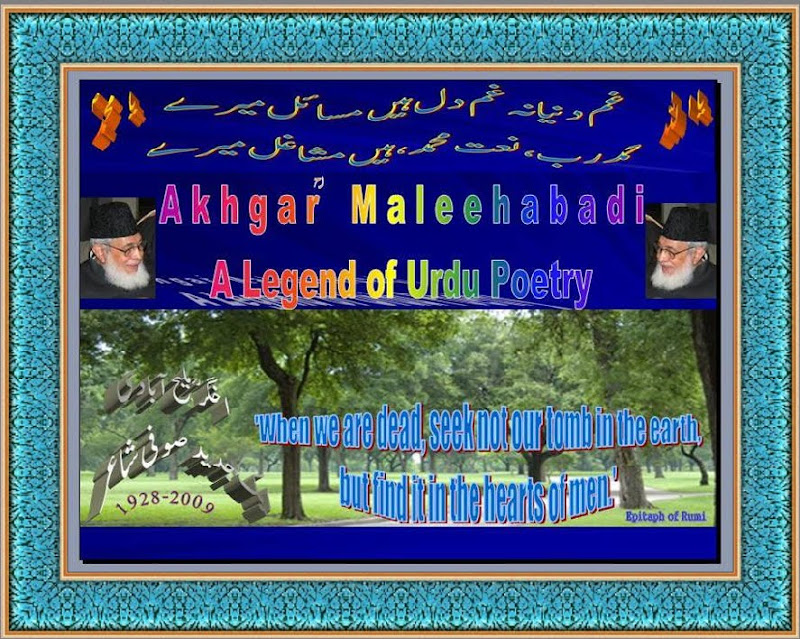
Today marks the 82nd birth anniversary of the Legendary American Urdu poet, Saiyid Mohammad Hanif Akhgar Malihabadi.
Labels:
82 nd Birth Anniversary,
Hanif Akhgar


Sunday, August 30, 2009
The Muslim University Alumni Associations of Americas Dedicate 2009 Mushairas to Sufi Akhgar's Memories
This is an email that has been received today from Dr. Abdullah Abdullah, of AMUAAA, Washington:
"The AAA Washington has planned to dedicate this year's [Oct-Nov 2009] Mushaira to the memory of Haneef Akhgar sahib. An other AAA association of Atlanta is planning to initiate a memorial for him. The details will be released later.
True Hanif sahib has a long association with AAA washington. he participated in our first Mushaira in 1975. Since then he always gave priority to our invitation. Washington loved him as many other places. To the best of my knowledge he was the last poet of Jigar tradition."
True Hanif sahib has a long association with AAA washington. he participated in our first Mushaira in 1975. Since then he always gave priority to our invitation. Washington loved him as many other places. To the best of my knowledge he was the last poet of Jigar tradition."
........................
Akhgars thank them all for this gesture and tribute.
First Ever Cruise Mushaira In Dallas

(DALLAS, TX) Al-Noor International organized a first of it’s kind Hindi / Urdu Cruise Mushaira (Poetry Recitation) held on the waves of Grapevine Lake on Friday, June 5, 2009 in Dallas, TX.
Famous Urdu language poetess from Pakistan – Mrs. Zakia Ghazal, and well-known Hindi poetess from India Dr, Anita Soni were the star attraction, and were especially invited to present their poetry on this event, which was presided by Poet Younus Aijaz.
The event was hatched by none other than Mr. Noor Amrohvi, a well-known poet, and a famous personality among Urdu/Hindi language literary circles of Al-Noor International, who with his brilliant idea, organized this event on the waves of Grapevine Lake onboard a double deck-cruise vesel “Lone Star Lady of Texas”. This was the first of it’s kind Hindi / Urdu Mushaira (Poetry Recitation) 2009 in the history of Dallas, TX.

The Mushaira was inaugurated by Owais Naseer, who welcomed the guests and invited on stage, the presider (chief of event), Mr Younus Aijaz, Urdu poetess from Pakistan Mrs. Zakia Ghazal, Hindi poetess from India Dr. Anita Soni, and chief guest Dr. Abha Aggarwal, who visited especially from New York to grace this occasion.
Famous poet, and PTV producer Mr. Iqbal Haidar mentioned about recent loss of Late Syed Hanif Akhgar, and dedicated this event in memory of this famous poet and Urdu literary personality, whose absence was greatly felt by those in Urdu literary circles. The audience welcomed this gesture and dedicated a “moment of silence” in his memory.
Mr. Noor Amrohvi highlighted the difficulties encountered in organizing this event. He also thanked the sponsors who contributed in making this event a successful one, including Mr. Hamid Abbas (and his team) of Texas King, who contributed the dinner in honor of the audience. He also thanked the contributions and help of Mr. Syed Azhar Bukhari, Mr. Jaipal Reddy, of Radio Salaam Namaste 104.9 FM and owner of Everest Heights,Mansoor shah and Mr. A.G. Cheeni (well known Radio Host), Dr. Amer Sulaiman (practicing Cardiologist), Mushtaq Ahmed (the author), Javed Siddiqui, Salim Akhtar, and Jawed Ansari who were instrumental and helpful in organizing this event.

Apart from the organizer and host poet Mr, Noor Amrohvi, who recited his poetry, local poets included Hamid Abbas, hassan Hashmi, Jawed Siddiqui, Rajeev Chakravarthy, Alam Siddiqui, Javed Rasheed, Nahed Shah, Zahra Chisti, Jawed Chowdhary, Tariq Hashmi, Iqbal Haidar, Khalid Khaja, Dr, Amer Suleman, Dr, Qaisar Abbas, Nadir Durrani, Saied Qureshi, and Sarwar Alam Raaz,
Guest Poetess from Pakistan Mrs Zakia Ghazal, and Hindi language guest poetess from India Dr. Anita soni were in the forefront, who attracted the audience with their melodic voice and heart-touching poetry on the waves on Grapevine Lake made the evening a memorable one for audience and poets.
The weather, with mild chilly-wind blowing on full-moon night was loved by the audience. Captain Ben and his team showed their gracious mastery of “Lone Star Lady of Texas” full throttle (speed) on the waves of Grapevine Lake. Laura Lemley’s (owner and operator of the vessel) co-operation was also appreciated.
The heart-winning and thought-provoking poetry by Mrs. Zakia Ghazal was applauded by audience. After completing four-hour cruise on the waves of Grapevine Lake, when the vessel reached ashore, the audience were fresh, happy, and satisfied to have participated and attended this “historical”, once-in-a-lifetime experience. The audience and guest poets appreciated Mr. Noor Amrohvi’s accomplishment in organizing this event, and also thanked Hamid Abbas and his team (Texas King) for the dinner. Everyone appreciated the event and congratulated the organizers, sponsors, and volunteers, who made this event successful, which was done to promote inter-cultural, inter-religious, inter-linguistic, and regional co-operation among citizens of India and Pakistan, residing in the United States.

Salaam to you all.
For and on behalf of Akhgars (The Haneef Family), we thank you very much for dedicating this unique Poetry Voyage to his memories.
As some of you might be aware, a Tribute Web Book Project has been launched by the Akhgars. This can be viewed at: http://akhgars.blogspot.com
If the event was video taped, we request you to please provide us a clip about Iqbal Haider's and others words spoken about late Sufi Poet Syed Mohammad Hanif Akhgar Maleehabadi.
Thanks, and best regards.
Mohammad bin Qasim
Justuju Media
justujumedia@gmail.com
For and on behalf of Akhgars (The Haneef Family), we thank you very much for dedicating this unique Poetry Voyage to his memories.
As some of you might be aware, a Tribute Web Book Project has been launched by the Akhgars. This can be viewed at: http://akhgars.blogspot.com
If the event was video taped, we request you to please provide us a clip about Iqbal Haider's and others words spoken about late Sufi Poet Syed Mohammad Hanif Akhgar Maleehabadi.
Thanks, and best regards.
Mohammad bin Qasim
Justuju Media
justujumedia@gmail.com
Sunday, August 2, 2009
کچھ تلخ تر ہی تلخیِ حالات ہوگئی

کچھ تلخ تر ہی تلخیِ حالات ہوگئی
لیکن ادا تو رسمِ شکایات ہوگئی
مخدوش تھی جو بات وہی بات ہوگئی
خوئے جفا رہینِ مفادات ہوگئی
اب ترکِ زندگی تو کوئی بات ہی نہیں
ترکِ تعلّقات کی جب بات ہوگئی
میں آئینہ اُنہیِں کی محبّت کا ہوں اگر
حیراں وہ کیوں ہیں دیکھ کے کیا بات ہوگئی
صحرا پہ ایک بُوند نہ ٹپکی تو کیا ہوا
کھُل کر سمندروں پہ تو برسات ہوگئی
اک مژدۂ وصال تھا اخگرؔ پیامِ مَوت
فرقت میں مر مِٹے تو ملاقات ہوگئی
٭
Saturday, August 1, 2009
ہم کو یہی تقدیر کا لکھا نظر آیا
پردے پہ پڑی رہ گئیں محفل کی نگاہیں
چہرہ کوئی مجھ کو پسِ پردہ نظر آیا

ہم کو یہی تقدیر کا لکھا نظر آیا
دل پھر ترے وعدے پہ بہلتا نظر آیا
دل سوزشِ پیہم سے ابلتا رہا لیکن
آنسو نہ کبھی کوئی نکلتا نظر آیا
میں نے تو کبھی آپ کو تنہا نہیں پایا
ہاں آپ کو محفل میں بھی تنہا نظر آیا
پردے پہ پڑی رہ گئیں محفل کی نگاہیں
چہرہ کوئی مجھ کو پسِ پردہ نظر آیا
ہر حسن میں موجود ملی عشق کی صورت
ہر حال میں اخگرؔ یہ تماشا نظر آیا
٭
Friday, July 31, 2009
Alami Mushaira on May 11, 2002
KARACHI, April 26: The 13th Alami Mushaira will be held at the Kashmir Road Sports Complex on May 11.
Azhar Abbas Hashmi of the Sakunan-i-Shaher-i-Quaid, the organization which is organizing the Mushaira, told Dawn that five poets were coming from India, three from the United States, one from Kuwait, one from Japan and eight from different cities of Pakistan.
Gulzar Dehlavi, Saghar Khyami, Popular Merathhi, Hina Taimuri, Sohail Lucknawi will come from India. Hanif Akhgar, Javed Masroor and Sardar Soz will come from the US. Kamal Azhar will come from Kuwait. Ataka will come from Japan.
Other poets taking part in the Mushaira are Iftikhar Arif (Islamabad), Izharul Haq (Islamabad), Sarfaraz Shahid (Islamabad), Mohsin Ehsan (Peshawar), Munir Niazi (Lahore), Fakhra Batool (Lahore), Javed Ahsan (Quetta) and Prof Ghulam Hussain Vani (Azad Kashmir).
From Karachi, Tabish Dehlavi, Jamiluddin Aali, Raghib Muradabadi, Saqi Amrohvi, Pirzada Qasim, Sarshar Siddiqui, Shabnum Roomani, Suhail Ghazipuri, Khalid Alig, Jaun Aliya, Nazar Amrohvi, Hijab Abbasi, Hanif Asadi, Jazib Qureshi, Rehan Roohi, Majid Khalil, Muslim Shamim, Amirul Islam Hashmi, Tariq Sabzwari, Zakia Ghazal and Farooq Abidi will take part.
Labels:
2002,
Aalmi Mushaira Karachi,
Hanif Akhgar
SAIYID M HANIF AKHAGAR MALIHABADI (IBA ALUMNI ~ 1970)

I offer my heartiest and sincerest congratulations to the students and graduates of IBA for being affiliated with one of the finest educational institution of the world. No doubt you are amongst the best of the students and you are the custodian of Pakistan. My request to you is to do your best in whatever field you start your career, seek wisdom and blessings from your parents, with complete faith in Allah for rewarding your relentless efforts. JAZAKUM ALLAH.
Sincerely

(Saiyid M Hanif Akhgar Malihabadi)
Sincerely
(Saiyid M Hanif Akhgar Malihabadi)
PS: Sameera Hashim, MBA IBA 2005, arranged a lecture by Sufi Akhgar at IBA during one of his visits in 2007
Wednesday, July 29, 2009
2007 Aligarh University Alumni California: Memories
COMMUNITY:
Proud Legacy: Sir Syed Day in the Bay Area
Poetry, a Mughlai dinner and some thoughtful reflections on how to address the acute disparity of wealth and education made Sir Syed Day marked by Aligarh University alumni a memorable event, writes Ras H. Siddiqui.

(Above): Volunteers and key supporters of the AMU Alumni Association of Northern California pose on Sir Syed Day at the India Community Center in Milpitas, Calif. [RAS H. SIDDIQUI photos]
Located in Northern India, Aligarh Muslim University is over 150 years old. In the San Francisco Bay Area the AMU Alumni Association of Northern California (www.amualumni.org) held its annual Sir Syed Day Banquet and International Mushaira the India Community Center in Milpitas, Calif. Nov. 17.
The evening started with a fine dinner from the Mughlai realm. After a recitation from the Holy Quran by Afzal Saeed Khan, Aftab Iqbal conducted the first half of the program. He expressed his admiration of Sir Syed: “Marnewale marte hain fana hote nahin.”
AMU Alumni of Northern California president Nihal Khan welcomed a full house. He reminded everyone that this was the 10th Anniversary of the association in Northern California. Nihal pointed to the Sir Syed Scholarship program that has thus far helped over 1,200 students. The program currently supports 140 students and will target over 200 next year. The Aligarh Education Endowment Fund was also highlighted (www.aeef.net). This served the needs of the underprivileged in India . The initial contribution to this fund by Drs. Kamil Hasan and Talat Hasan was appreciated. Nihal went on to explain that the fund was not exclusive to one community. His quote from the poet Majaz resonated in the hall as keynote speaker Dr. M. Humayon Qayoumi was introduced.

(Right): Keynote speaker Dr. M. Humayon Qayoumi, president of Cal State East Bay University.
Qayoumi, originally from Afghanistan, is currently CSU East Bay president. He quoted Urdu’s greatest poet Mirza Ghalib, and taking a page from Sir Syed’s rich contributions to Muslims over 150 years ago, brought us back to today. “How can we make education a liberating force?” he asked. From globalization in the flat world where benefits are not evenly distributed with millions facing food, water and sanitation shortages, the question of humankind as a whole being better off today remains unanswered. The keynote speech took the audience on quite a journey. From Maulana Azad who was also India’s first education minister, back to the Gupta empire in Indian history, to the Muslim contributions to the field of medicine, history and science and rational thinking via Ibne Sina and Al Beruni and India’s valuable contribution to mathematics, the basic discoveries paved the way for today’s communication (the Internet, You Tube etc). Yet in spite of the improved communication many people in America could still not point to Iraq and Afghanistan correctly on the world map and some could not do the same for the Pacific Ocean! He ended his keynote with a quote from the great Bengali poet Tagore.
The first part of the program ended with the traditional singing of the Tarana or anthem of Aligarh Muslim University: “Yeh mera chaman hai mera chaman, Mein apne chaman ka bulbul hoon…” written by Asrarul Haq Majaz Lucknawi.
The second part of the Sir Syed Day is the Urdu language Mushaira or poetry recital. Poets from India, Pakistan and the United States took part in this fine tapestry of talent. Abidullah Ghazi (Chicago) conducted the proceedings. Ghazi also commended the local community on the ICC, a fine facility.
“Humari tehzeeb aik numainda tehzeeb hai,” said Ghazi, referring to the cultures represented in Urdu, a South Asian language enriched by Turkish, Persian and Arabic from where its poetry derives much inspiration. And inspiration was not in short supply this evening as the first round of poetry began with Mahnaz Naqvi presenting “Mohabbat ke safar mein” and “Mila na mila.” Local software engineer Vasmi Abidi next attacked the issue of alienation in his verses. Ironically, according to him, in the age of global communication, email and the Internet, people do not know their own neighbors. His “Jis kay ghar say mila hai mera ghar” was really moving.
Renowned poet from Pakistan Zakia Ghazal literally stole the evening with her tarannum singing style. Zakia’s famous verses on Karachi are getting a great deal of notice recently. I will leave her “Koi rishte nahin to kiya haq hai aap ko faislah sunanay ka” to the readers to translate. Ghazal’s poetry etches a painfully clear portrait of events around her.
Urdu poetry is not without its humorous tangent. Khamakhah Hyderabadi (India ) is certainly a true representative of that craft. “Nek seerat ho to soorat ki zaroorat kiya hai,” (With honest intentions, who needs good looks?) was one example. Hyderabadi led the audience to rollicking laughter with his wit and sarcasm.
Mushaira conductor Abidullah Ghazi (Chicago) presented his work. “Loot gaye dar badar ho gaye, kuch idhar, kuch udhar ho gaye” spoke of broken connections. His “Waqt pe nazar rakhna, yeh badalta rehta hai, aaj meri baari hai, kal tumhari hai” referred to changing political conditions.
Rahat Indori (India) continued along similar lines. He began by saying: “Is chhotese Hindustan aur chhotese Pakistan ko salaam karta hoon.” His “Kiyoon hai” and “Aur hai” were very well received.
Presiding over the Mushaira, senior poet Hanif Akhgar proved his level of skill and proceeded to deliver both ghazals and nazms. “Wajood mera kahin bhi ho, meri rooh mere watan mein hai,” he said.
 Ras Hafiz Siddiqui is a South Asian American writer
who lives in Sacramento, Calif.
Proud Legacy: Sir Syed Day in the Bay Area
Poetry, a Mughlai dinner and some thoughtful reflections on how to address the acute disparity of wealth and education made Sir Syed Day marked by Aligarh University alumni a memorable event, writes Ras H. Siddiqui.
(Above): Volunteers and key supporters of the AMU Alumni Association of Northern California pose on Sir Syed Day at the India Community Center in Milpitas, Calif. [RAS H. SIDDIQUI photos]
Located in Northern India, Aligarh Muslim University is over 150 years old. In the San Francisco Bay Area the AMU Alumni Association of Northern California (www.amualumni.org) held its annual Sir Syed Day Banquet and International Mushaira the India Community Center in Milpitas, Calif. Nov. 17.
The evening started with a fine dinner from the Mughlai realm. After a recitation from the Holy Quran by Afzal Saeed Khan, Aftab Iqbal conducted the first half of the program. He expressed his admiration of Sir Syed: “Marnewale marte hain fana hote nahin.”
AMU Alumni of Northern California president Nihal Khan welcomed a full house. He reminded everyone that this was the 10th Anniversary of the association in Northern California. Nihal pointed to the Sir Syed Scholarship program that has thus far helped over 1,200 students. The program currently supports 140 students and will target over 200 next year. The Aligarh Education Endowment Fund was also highlighted (www.aeef.net). This served the needs of the underprivileged in India . The initial contribution to this fund by Drs. Kamil Hasan and Talat Hasan was appreciated. Nihal went on to explain that the fund was not exclusive to one community. His quote from the poet Majaz resonated in the hall as keynote speaker Dr. M. Humayon Qayoumi was introduced.
(Right): Keynote speaker Dr. M. Humayon Qayoumi, president of Cal State East Bay University.
Qayoumi, originally from Afghanistan, is currently CSU East Bay president. He quoted Urdu’s greatest poet Mirza Ghalib, and taking a page from Sir Syed’s rich contributions to Muslims over 150 years ago, brought us back to today. “How can we make education a liberating force?” he asked. From globalization in the flat world where benefits are not evenly distributed with millions facing food, water and sanitation shortages, the question of humankind as a whole being better off today remains unanswered. The keynote speech took the audience on quite a journey. From Maulana Azad who was also India’s first education minister, back to the Gupta empire in Indian history, to the Muslim contributions to the field of medicine, history and science and rational thinking via Ibne Sina and Al Beruni and India’s valuable contribution to mathematics, the basic discoveries paved the way for today’s communication (the Internet, You Tube etc). Yet in spite of the improved communication many people in America could still not point to Iraq and Afghanistan correctly on the world map and some could not do the same for the Pacific Ocean! He ended his keynote with a quote from the great Bengali poet Tagore.
The first part of the program ended with the traditional singing of the Tarana or anthem of Aligarh Muslim University: “Yeh mera chaman hai mera chaman, Mein apne chaman ka bulbul hoon…” written by Asrarul Haq Majaz Lucknawi.
The second part of the Sir Syed Day is the Urdu language Mushaira or poetry recital. Poets from India, Pakistan and the United States took part in this fine tapestry of talent. Abidullah Ghazi (Chicago) conducted the proceedings. Ghazi also commended the local community on the ICC, a fine facility.
“Humari tehzeeb aik numainda tehzeeb hai,” said Ghazi, referring to the cultures represented in Urdu, a South Asian language enriched by Turkish, Persian and Arabic from where its poetry derives much inspiration. And inspiration was not in short supply this evening as the first round of poetry began with Mahnaz Naqvi presenting “Mohabbat ke safar mein” and “Mila na mila.” Local software engineer Vasmi Abidi next attacked the issue of alienation in his verses. Ironically, according to him, in the age of global communication, email and the Internet, people do not know their own neighbors. His “Jis kay ghar say mila hai mera ghar” was really moving.
Renowned poet from Pakistan Zakia Ghazal literally stole the evening with her tarannum singing style. Zakia’s famous verses on Karachi are getting a great deal of notice recently. I will leave her “Koi rishte nahin to kiya haq hai aap ko faislah sunanay ka” to the readers to translate. Ghazal’s poetry etches a painfully clear portrait of events around her.
Urdu poetry is not without its humorous tangent. Khamakhah Hyderabadi (India ) is certainly a true representative of that craft. “Nek seerat ho to soorat ki zaroorat kiya hai,” (With honest intentions, who needs good looks?) was one example. Hyderabadi led the audience to rollicking laughter with his wit and sarcasm.
Mushaira conductor Abidullah Ghazi (Chicago) presented his work. “Loot gaye dar badar ho gaye, kuch idhar, kuch udhar ho gaye” spoke of broken connections. His “Waqt pe nazar rakhna, yeh badalta rehta hai, aaj meri baari hai, kal tumhari hai” referred to changing political conditions.
Rahat Indori (India) continued along similar lines. He began by saying: “Is chhotese Hindustan aur chhotese Pakistan ko salaam karta hoon.” His “Kiyoon hai” and “Aur hai” were very well received.
Presiding over the Mushaira, senior poet Hanif Akhgar proved his level of skill and proceeded to deliver both ghazals and nazms. “Wajood mera kahin bhi ho, meri rooh mere watan mein hai,” he said.
Ras Hafiz Siddiqui is a South Asian American writerwho lives in Sacramento, Calif.
The Politics of Language: by Abdul Jamil Khan
Urdu/Hindi: An Artificial Divide
African Heritage, Mesopotamian Roots, Indian Culture & British Colonialism
African Heritage, Mesopotamian Roots, Indian Culture & British Colonialism
- Abdul Jamil Khan

EXCERPT: Syed Mohammed Hanif Akhgar, the leading US Poet .....

Book overview
In a blow against the British Empire, Khan suggests that London deliberately set India's Hindu and Muslim populations against each other in the 1800s by artificially splitting their one language in two, then burying the evidence in obscure scholarly works outside the public view. "Divide and rule" - the British were experts at that. All language is political - and so is the boundary between one language and another. The author analyzes the origins of Urdu, one of the earliest known languages, and propounds the iconoclastic views that, (1) Hindi came from pre-Aryan Dravidian and Austric-Munda (rooted in the Middle East/Mesopotamia), not from Aryan Sanskrit, and (2) Hindi's script came from the Aramaic system, similar to Greek. Urdu/Hindi: An Artificial Divide integrates the "out of Africa" linguistic evolution theory with the fossil linguistics of the Middle East, and discards the theory that Sanskrit descended from a hypothetical proto-Indo European language and by degeneration created dialects, Urdu/Hindi and others. It shows that several tribes from the Middle East created the hybrid by cumulative evolution. The oldest groups, Austric and Dravidian, starting in 8000 BC, provided the grammar/syntax plus about 60% of vocabulary, Sanskrit added 10% after 1500 BC and Arabic/Persian 20-30% after AD 800. The book reveals Mesopotamia as the linguistic melting pot of Sumerian, Babylonian, Elamite, Hittite-Hurrian-Mitanni, with a common script and vocabularies shared mutually and passed on to Indo-European, Sanskrit, Dravidian, Arabic and then to Hindi/Urdu; in fact the author locates oldest evidence of Sanskrit in Syria. The book exposes the myths of Sanskrit or Hebrew as "revealed" languagesand examines the fiction of linguistic races, i.e. Aryan, Semitic. The book supports the "one world concept" and reveals the potential of Urdu/Hindi to unite all genetic elements, races and regions of the Indo-Pakistan sub-continent. Khan bolsters his hypothesis with copious technical linguistic examples and quotes masters of Urdu/Hindi prose and poetry of the last three centuries, showcasing the passionate expressiveness of the language. * Abdul Jamil Khan, MD, served as chairman of a teaching hospital and as a professor of pediatrics he taught infant speech development in New York. From there, his research has extended into linguistics and history. His impetus stems from his early education, as he learned six languages by 10th grade and had to face political claims regarding "Divine Arabic" and "Divine Sanskrit," and experienced the tragedies of the British division of India and its language. Limited preview - 2006 - 400 pages Sound Bite “Divide and rule” — the British were experts; and in creating out of one language the notion of a separate "Hindi" for Hindus in colonial India and "Urdu" for Muslims, they used even the definition of languages to set their colonial subjects against one another. Further, this language had its origin from Austric and Dravidian and not from the Indo-European Sanskrit, as is the dogma. About the Author Abdul Jamil Khan, M.D., of New York, served as chairman of a teaching hospital and a professor of pediatrics specialized in infant speech development; he has now extended himself into linguistics studies, challenged by the pseudo science of race- and religion- driven linguistics, which he implicates in the anti-Semitic holocaust; its Indian parallel, the partition massacre; and other human right violations, a gross anathema to a physician-humanist. His drive, though, stems from early education, learning six languages by 10th grade, facing political claims of a “divine Arabic” and “divine Sanskrit” and experiencing the tragedies of British division of India and its language. Dr. Khan, an author of some hundred medical publications, has lately spoken on humanities, linguistics and cultural themes at universities and elsewhere, including Brooklyn Historical society. He also authored a book on his Afghan ancestors' migration to India. Dr. Khan is a co-editor of a periodical “Health Message” and has received media attention in the US and in India. He was featured by Brad Gooch in God Talk (Random House 2002), and Linda Cateura in Voices of American Muslims (Hippocrene Books 2005). In re-synthesizing the genetic history of Urdu-Hindi and exposing the myth of the Sanskrit language and its script, he builds on ideas promoted by Italian linguist Cavalli Sforza and the newest classification of languages by Merrit Ruhlen.
Book News The 'lingua franca' of the Indo-Pakistani people is one language, claims Khan, called Hindi when written in Nagari and Urdu when written in Arabic. He says it is not descended from Sanskrit, as conventionally believed, but is 10-12,000 years old and was influenced early by the Austric-Munda and Dravidian language families. Leaving aside any religious argument, he buttresses his theory with evidence from evolution, Sumerian, and the European concept of mythical races linked to linguistic families. His experience teaching pediatrics and infant speech development led him to the study of linguistics and history. |
Tuesday, July 28, 2009
Munno Bhai in a Mushaira with Haneef Akhgar: 2004 Washington
Monday, June 21, 2004
OP-ED: The final battle —Munnoo Bhai

GENERAL Montgomery, a hero of World War II, was once asked how many wars he had won. “I won only the last battle,” he had answered. It is the last battle, of course, that determines whether one should count for a winner or loser. The trouble is, nobody knows which battle will prove the last.
Even US President George W Bush, the commander-in-chief and leader of the world’s greatest war machine, is not sure of the battle that will crown him as a world conqueror or condemn him for life to the humiliation of defeat. Worse still, a defeat may not be limited to his person. Like the humiliation in Vietnam it could wound the psyche of the entire nation. Fareed Zakariya of the US weekly Newsweek says the US forces that conquered Baghdad have done well to concede defeat in Falluja, Karbala and Najaf. Conceding defeat, he believes, is better and wiser than being beaten.
The Republican C-in-C of the United States has faced defeat on three fronts besides Falluja, Karbala, and Najaf. Considering occupation of Baghdad their final victory, President Bush and Secretary for Defence Rumsfeld had proudly declared that there would be no need to send more US troops to Iraq. But the need arose and 20,000 US troops had to be sent to reinforce the occupying forces. When it came to invading Iraq, the US government — having pushed Afghanistan into early stone-age — ignored the United Nations. Later it ruled out any role for the UN in Iraq.
It has since been forced to accept the UN’s presence in Iraq after June 30 and to admit its important role in setting up the new Iraqi government. Having seen the consequences of the political blunder in firing the half-million-strong Iraqi army to liquidate the influence of the Baath Party, the US is now forced to seek cooperation from the same Baath Party. Had the US adopted this attitude 14 months ago, Fareed Zakariya believes, the situation would have been different.
A cartoon in the magazine depicts the ground reality. President Bush is shown inviting the new rulers of Iraq to receive the keys to power. Nobody, however, is willing to step ahead to receive the keys because this requires stepping into territory targeted by popular resistance. The American government seems to have neglected the English idiom advising those finding themselves in a well to stop digging and focus instead on safely getting out.
In Washington, where I accompanied Amjad Islam Amjad, Himayet Ali Shair and Hanif Akhgar to participate in the annual meeting of the Association of Pakistani Physicians in North America, Pakistani journalists familiar with diplomatic activities told me the US foreign policy, particularly the policy on the Middle East and the Iraq war had slipped out of the hands of Secretary Rumsfeld and the Pentagon and returned to the National Security Council. Council member Robert Blackwell, they said, was now running the Iraq policy. The blunders caused by the US rulers’ hunger and thirst for oil over the past 14 months are, however, hard to undo.
The Pakistani journalists in Washington believe the only way out of the pit for the US is to sacrifice George W Bush, the president who lost the popular vote in the last election. The final battle in the war for protecting US interests in the Middle East and Gulf countries will have to be fought in the form of presidential election this November. A defeat for Bush will be more important than a victory for John Kerry. Some battles have to be lost on some fronts to win the war.
Pakistani journalists familiar with the US policies say the November 2004 US election results may be more surprising than the results of the recent Indian elections. The thinking that stopped Ahmad Chalabi from becoming Iraq’s new Saddam Hussein can choose to sacrifice Bush to get out of the pit in Iraq. A mistake once may be forgivable; repeating it is an offence.
Munnoo Bhai is a writer and columnist
http://www.dailytimes.com.pk/default.asp?page=story_21-6-2004_pg3_3
Urdu Markaz California Mushaira News November 1997
The Urdu Markaz International (California) held a Mushaira on 14 November 1997 at Buena Park, California. It was presided by the famous music director and poet Naushad Ali Lucknavi. Guest poets included: Hanif Akhgar, Ziaul Haq Qasmi, Shakeel Azad, Abbas Tabish, Zafar Rizvi, Zafar Gorakhpuri, Azhar Javeed, Naseem Garogh, Abdullah, and Sabahat Asim.
Subscribe to:
Posts (Atom)
Site Design and Content Management by: Justuju Media

Literary Agents & Biographers: The Legend of Akhgars Project.- Click Logo for more OR eMail: Justujumedia@gmail.com



Comments