

English Translations

Please Click above for Akhgar Poetry in English
Monday, November 23, 2009
Sunday, November 22, 2009
Saturday, November 21, 2009
Tributes to Akhgar اخگر کو خراج تحسین
1 Karachi Club, Press Committee, Poetry Recital - Satrday, November 21, 2009 - Professor Enayat Ali Khan
2 Karachi Club, Press Committee, Poetry Recital - Saturday, November 21, 2009 - Ms Shahida Hasan, Poetess
Thursday, November 12, 2009
A Tribute to Akhgar: Karachi Press Club Nov 21, 2009
Karachi Press Club's literary committee has announced that a Mushaira is being organized on Nov 21, 2009 to pay tributes to the Legendary Poet Late Sayyid Mohammad Hanif Akhgar Maleehabadi.
The admission is by invitation. Cards can be obtained through Mr. Aneeq Ahmed, and Majid Khalil.
Monday, September 28, 2009

Sunday, September 13, 2009
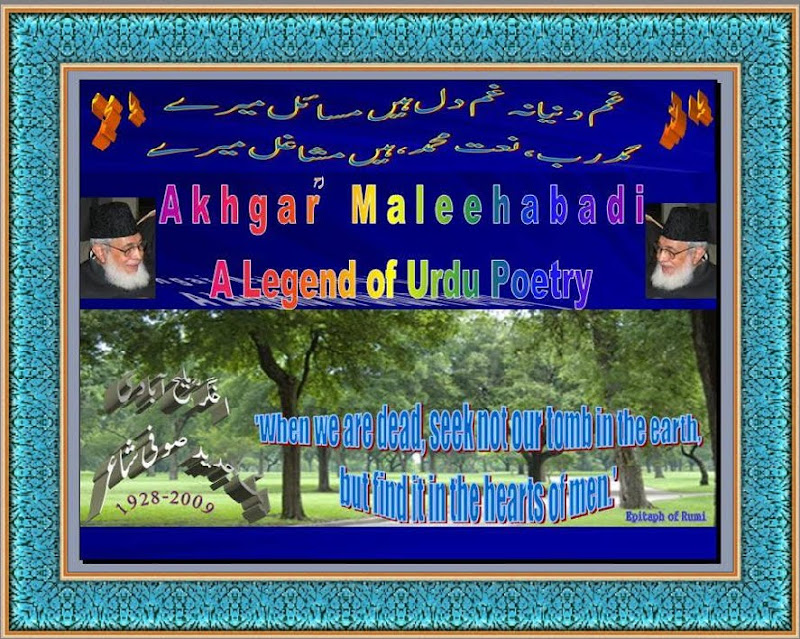
Hanif Akhgar Malihabadi is No More in this Mortal World - Pakistan Link
June 5, 2009
Hanif Akhgar Malihabadi Is No More
The last symbol of Jigar Muradabadi school and flag bearer of Urdu ghazal in North America, Hanif Akhgar Malihabadi, is no more. He died on May 31, 2009 at his residence in Dallas, Texas. He was a classical poet of ghazal and his ghazals were an extension of Jigara Muradabadi and Asghar Gondvi.
Syed Muhammad Hanif became Syed Muhammad Hanif “Akhgar” at a very young age when he won the 1st prize in a `Tarahi-Mushaira` at Amir-ud-Daulah Islamia College in 1945. Urdu poetry was his passion and his first collection of Ghazal Chiragaa(n) was published in 1989. In 1997, his second collection Khayaabaa(n) was published. His last book came as collection of “Naat” titled Khalq-eMujassam in 2003.
Hanif Akhgar completed his Masters in Business Administration (MBA) from the Institute of Business Administration, University of Karachi . He also completed his Diploma in Industrial Financing from London School of Economics and Political Science, University of London.
He joined United Nations (UN) as International Civil Servant (ICS) in 1971 and served in different parts of the world and retired on 2nd May 1989 as Division Chief of United Nations Capital Development Fund Division for Asia Pacific, Latin America and Arab States and settled down in New York with his family. He was also a permanent representative of World Assembly of small and medium Enterprises (WASME) in United Nations at New York. Hanif Akhgar moved to Dallas , Texas , in 2007.
He has left behind his wife, seven daughters and four sons. His sad demise will be felt for a long, long time by Urdu lovers in America and all across the Urdu-speaking world.
Labels:
Hanif Akhgar No More,
News English,
Pakistan Link


Saturday, September 12, 2009
تحدیث نعمت: خلق مجسم - حنیف اخگر

-
خلق مجسم
تحدیثِ نعمت
سید محّمد حنیف اخگرؔ ملیح آبادی
الحمدللہ! میری یہ دلی آرزو، کہ اپنی زندگی میں ہی اپنا خراج عقیدت اور تمنّائے غلامی اپنے آقاؐ اور وجہِ تخلیقِ کائنات سیّدنا و مولانا حضرت محمّد الرسول ﷺ کی خدمت میں ایک مجموعہِ حمد و نعت و منقبت کی شکل میں پیش کروں، اللہ تعالیٰ کے فضل و کرم سے پوری ہو رہی ہے۔ اور اس کے لیے میرے معبود ہی نے کہ وہی مسبب الاسباب ہے تمام عناصر فراہم فرمائے۔ اور میری یہ مختصر تحریر اسی تحدیثِ نعمت کے فرض کی ادائیگی کے لیے ہے۔ اور یہ تحدِیثِ نعمت و ہ عالم الغیب اور علیم بذاتِ الصدور جانتا ہے کہ میرے اسی احساسِ تشکّر پر مبنی ہے۔ ویسے میں اپنی بقیہ زندگی اگر سجدے ہی میں پڑا رہوں تو بھی معبود کے اس شکر کا جو مجھ پر لازم ہے، ایک ذرّہ کے برابر بھی حق ادا نہ ہوگا۔
حمد و نعت و سلام و منقبت وہ اصنافِ سُخن ہیں، جن کے لیے فطری شاعرانہ صلاحیّت، مشقِ سُخن، وسیع مطالعہ، ریاضتِ فکری، اور فصاحتِ زبان سے بھی پہلے اور کہیں زیادہ اہم عُنصر رب العزّت کی طرف سے انعام کردہ توفیق ہے کہ جو اس طرف ذہن و فکر کو مائل کرتی ہے۔ اور اس قدر مائل کرتی ہے کہ شوق شعورِ عشق تک آجاتا ہے۔ یہ توفیق انسان کو صرف ذاتِ باری تعالیٰ انعام کرتی ہے۔ مجھے یہ توفیق اپنے والدین مرحومین کے سایہ میں نصِیب ہوئی۔ میرے والد مرحوم حضرت قاضی سیّد محمد شریف اثرؔ کسمنڈوی اور میری والدہ مرحومہ سیّدہ رضی النِّسا دونوں بڑے مُتّقی اور پرہیز گار تھے، اور سرکارِؐ دوعالم کے نام پر جان و دل سے نثار تھے۔ میری امّی مرحومہ کا تو یہ حال تھا کہ سرکارِ دوعالمؐ کا نام زبان پر آتے ہی ان کی آنکھوں میں ایک چمکدار نمی فوراً آجاتی تھی، اور جب میں امیر مینائی یا مُحسن کاکوروی یا قبلہ ابّا میاں مرحوم کی کہی ہوئی کوئی نعت ترنّم سے پڑھتا تو وہ چمکدار نمی گوہرِ غلطاں کی طرح ان کی پلکوں سے چھن کر ان رُخساروں پر ایسی لگتی تھی جیسے گُل ہائے تازہ پر عرقِ شبنم اور ابّا میاں مرحوم سبحان اللہ، ماشااللہ قدرے زور سے کہتے اور درود زیرِ لب پڑھتے رہتےتھے۔ بہت کم سِنی ہی میں امّی نے مُجھ کو کہانیوں کی طرح بہت سے قصص الانبیاؑء، مثلاً حضرت ابراہیمؑ پر آگ کے گلزار ہوجانے کا واقعہ، حضرت موسیٰ ؑ کو کوہِ طُور پر نبوّت ملنے اور طُور پر ہی برقِ تجلّی سے بے ہوش ہونے اور کوہِ طُور کے جلنے کا واقعہ، حضرت نوحؑ کی کشتی اور قومِ نوحؑ پر طوفانی بارش کا عذاب اور ان کے بیٹے کے سلسلہ میں اُن کی دعا اور رب العزّت کا جواب، قومِ لُوط پر پتھراؤ کا عذاب، اور ساتھ ہی حضوُر سرکارِ دوعالمؐ کا کلمہ کنکریوں کی زبانی، معجزہء شق القمر، معراج کا واقعہ، وغیرہ بار بار سُنائے۔ حضرت ابراہیم ادہم ؓ اور رابعہ بصری ؓ کے واقعات وکرامات سن کر تو میں یہ سمجھتا تھا اور اب بھی سمجھتا ہوں کہ میرے والد ابراہیم ادہمؓ ثانی، اور میری والدہ رابعہ بصریؓ ثانی تھیں۔ ان دونوں کے سائے میں مجھ کو رب العزّت نے پروان چڑھا کر اور ایسے اعلیٰ مرتبت مسلمانوں کی اولاد بنا کر خالقِ کائنات نے مُجھ پر اتنا بڑا احسان کیا کہ اس کا شکر کماحقہٖ ادا نہیں ہوسکتا۔ اس عظیم احسان کو اگر میں اُمّ الاحسان کہوں تو درست ہوگا، عین صداقت ہوگا، کیونکہ اس احسان کے ہی ضمنی فوائد میں نماز کی پابندی نصیب ہوئی۔ جو اوّل اوّل امّی مرحومہ ہی کی خوشی اور ان سے ملنے والی شاباشی کے لیے شروع ہوئی۔ رسولؐ اللہ سے محبّت بھی اسی طرح ہوئی کہ ان سے میرے والدین بہت محبّت کرتے تھے،ا ور مجھ کو فطرتاً بس وہی پسند ہوتا تھا جو انہیں پسند ہو۔ امّی مرحومہ نے مجھ کو والدین کے احترام اور ان کے درجہ کا احساس کرنا بھی بچپن ہی میں سکھا دیا تھا۔ ان کی تعلیمات کو ذہن نشین کرلینا،ا ور ان کا حکم بے چوں و چرا مان لینے اور ان کی خوشی ہی میں اپنی خوشی کا یقین رب العزّت کی طرف سے ودیعت اور انعامِ خاص تھا۔ اور اس میں توفیقِ حمد و نعت و سلام و منقبت شامل تھی۔
دوسرا اہم عُنصر رسول اللہ صلی اللہ علیہ وسلّم کی محبّت ہے۔ جو ایک اور انعام خاص ہے۔ بلکہ بعض اوقات تو یہ لگتاہے کہ یہ دوسرا نہیں بلکہ پہلا عنصر ہے کہ اسی محبّت سے تو وہ گُداز قلبی اور لہجہ کی نرمی، پاکیزگیء خیال، اور احتیاطِ لفظی نصیب ہوتی ہے۔ ۔۔ جو حمد و نعت و سلام و منقبت کے لیے لازم ہوتی ہے۔ مجھ کو سرکارؐ سے جو محبّت ہوگئی، وہ میرے لیے دراصل والدین کی سرکارؐ سے محبّت ہی کا عکس تھی۔ بہر حال، اس قدر مقدّس سمندر میں سے جو ایک قطرہ بھی ملا ہے وہ انشااللہ میری دنیا بلکہ آخرت کو بھی سنوارنے کے لیے کافی ہوگا، اور میری آنے والی نسلوں کے لیے بھی ۔۔ اگر میں احتیاط سے اس تحفہ کو اپنی اولاد کے توسّط سے مستقبل کی طرف اللہ پاک کے فضل و کرم سے منتقل کرسکوں۔ حق تو یہ ہے کہ میری والدہ مرحومہ تو بہت جلد کوچ کرگئی تھیں، لیکن میرے والدمرحوم تو میری اولادوں کی بھی بنیادی تربیت کرگئے ہیں، اور اللہ کے اس انعام کا شکر شب وروز متواتر جبیں سائی اور تسبیح سے بھی ادا کیا جائے تو بھی سیری نہ ہو۔
تیسرا عنصر تلمُّذ، یعنی حمد ونعت و سلام و منقبت کے لیے کسی استاد شاعر کی شاگردی کا شرف حاصل کرنا ہے۔ اس سلسلہ میں بے حد خوش نصیب ہوں، کہ رب العزّت نے مجھے اس خفّت سے بچالیا، کہ اگر کوئی اچھا شعر ہوگیا تو سامعین اس کو استاد سے منسو ب کردیں، اور کوئی شعر پسند نہ آئے تو یہ کہا جائے کہ لائق استاد سے بھی یہ نالائق کچھ حاصل نہ کرپایا۔ لیکن میں نے سیکھا تو بڑے بڑے استادوں سے ضرور ہے۔ اور وہ یوں کہ میں نے اپنے بڑوں سے کسبِ ہُنر کیا ہے۔ مثلاً، غزل کے سلسلے میں غالبؔ، داغؔ، جگرؔ، حسرتؔ، اصغرؔ، فانیؔ، اور شاعرؔ لکھنوی کے کلام کا بغور مطالعہ کرکے ۔ ۔ ۔ ان کے شعری محاسن اور تراکیب، صنائع اور بدائع کو مدِّ نظر رکھتے ہوئے ان کی زمینوں میں یعنی انہیں کی غزلوں کے کسی مصرعہ کو مصرعہ ء طرح بنا کر غزلیں کہی ہیں۔ اور بہ ایں ہمہ کوشش یہ کی ہے کہ کوئی بات کسی نئے زاویے سے اپنے لہجے میں کہی جائے۔ میرے دو مجموعے، “چراغاں”، اور “خیاباں” اس کے شاہد ہیں۔ ان میں زیادہ تر طرحی غزلیں ہیں، جو عہدِ حاضر اور ماضی کے اساتذہ کی زمینوں میں ہیں۔حمد و نعت و سلام و منقبت کے سلسلے میں بھی میں اپنے والدین کی پسندیدگی کے تحت مرحوم اباّ میاں کے علاوہ امیرؔ مینائی، محسنؔ کاکوروی، جگرؔ مرادآبادی، حسرتؔ موہانی کی نعتوں کے بغور مطالعہ کے ساتھ ساتھ پروفیسر حفیظؔ تائب، رونقؔ بدایونی، عبدالحمید صدّیقی لکھنوی، اور بالخصوص شاعرؔ لکھنوی مرحوم کی نعتوں سے نہ صرف بار بار محظوظ ہوا ہوں، بلکہ ان کو اپنے لیے ایک معیار مقرّر کیا ہے، اور بہت کچھ سیکھا ہے۔ میں ان سب کو اُستاد مانتا ہوں اور جانتا ہوں۔ یعنی ان کی فنّی مہارت کا قائل ہی نہیں، خود کو اس پر حسبِ توفیق مائل ہوتا بھی نظر آتا ہوں۔ اور آمادہ بھی پاتا ہوں۔ اس طرح یہ تیسرا جزوِ لازمی بھی خدا کے فضل سے مُیسّر ہوگیا۔
چوتھا عُنصر مناسب ماحول ہوتا ہے۔ الحمدللہ مجھے ملیح آباد ہی میں عمر کے ابتدائی سولہ سال گزارنے کا موقع ملا۔ جہاں آئے دن میلاد شریف کی پاکیزہ محفلیں تقریباً ہر ماہ کسی نہ کسی محلّے میں اور خاص طور پر ماہِ ربیع الاوّل میں روزانہ دو ایک محفلیں ہوتی تھیں۔ جہاں مجھ کو بھی نعت خواں کی حیثیت سے لوگ بڑی قدر و منزلت سے مدعو کرتے تھے، اور میں قبلہ ابّا میاں مرحوم کے ساتھ شرکت کرتا تھا۔ پھر لکھنٔو میں چھ سال قیام رہا۔ جس میں سے تقریباً تین سال میرا قیام کرنل نواب راحت سعید خاں صاحب چھتاری مرحوم کے ساتھ پہلے راجہ صاحب سلیم پور کی کوٹھی واقع قیصر باغ میں، اور پھر ڈاکٹر بھاٹیہ کی کوٹھی واقع ریڈچی روڈ میں رہا۔ امیرالدولہ اسلامیہ کالج کا طالب علم تھا، اور باقاعدہ شاعری کا آغاز 1945ء میں کالج ہی کے ایک طرحی مشاعرہ میں اوّل انعام کے حصول کے ساتھ ہوچکا تھا۔ لکھنؤ کا ماحول شعر و شاعری کے لیے نہایت موزوں تھا، اور وہاں نشرگاہ مسلم لیگ امین آباد سے روزانہ ترانوں کی نشریات اور پاکستان کے سلسلہ میں نت نئے قطعات کا زور، اور نواب صاحب کے دولت کدہ پر تقریباً روزانہ ہی اس دور کے ممتاز شعراء کی محفلیں اور عشائیے ، [منعقد ہوتے]جن میں ناچیز کو بھی شرکت کے بیشمار مواقع نصیب ہوئے۔
پھر دسمبر 1950ء میں ہم لوگ لکھنئو سے ہجرت کرکے کراچی آگئے۔ والدہ صاحبہ کا تو 31 دسمبر 1947ء کو انتقال ہوگیا تھا۔ قبلہ ابّا میاں مرحوم کی سرکردگی میں ہم سب بھائی بہن اور میری اہلیہ [میری شادی 21 جون 1950ء کو ہوگئی تھی] کراچی آگئے تھے۔ لیکن ملیح آباد اور لکھنؤ میں مجھے جو ماحول اللہ کے فضل سے نصیب ہوا، وہ میرے ذوقِ شاعری کے لیے بہت مفید ثابت ہوا۔ اس کے بعد تقریباً بائیس [22] سال حصولِ تعلیم اور کسبِ معاش میں اور اس قدر زیادہ مصروفیت رہی کہ اس عرصہ میں شاذ و نادر ہی کسی مشاعرہ میں کسی نہ کسی دوست کے اصرار پر جو مجھ سے ایک شاعر کی حیثیت سے واقف ہوتا تھا شرکت کرپاتا تھا۔ [اس بائیس برس کے عرصہ میں میری برطانیہ، اور ریاست ہائے متّحدہ امریکہ میں تعلیم اور ٹریننگ کا زمانہ بھی شامل ہے۔] پھر جنوری 1973ء میں اقوام متحدہ سے وابستہ ہوگیا، اور نیویارک میں معاشی آسودگی کے ساتھ ساتھ مجھ کو شعر و سخن کےلیے وقت بھی مُیسّر ہوگیا۔ اسی کے ساتھ یہاں مجھ کو لکھنؤ کے ایسے احباء جو مجھ سے بے لوث محبّت کرتے تھے اور میری شاعری کو پسند کرتے تھے مل گئے۔ اور ان کے تعاون اور اصرار پر یہاں ادبی سرگرمیاں زور و شور سے شروع ہوگئیں۔ 1976ء سے 1980ء تک میں یونائیٹیڈ نیشنز ڈیویلپمنٹ پروگرام کے ڈپٹی ریجینل نمائندہ برائے سعودی عرب، بحرین، قطر، متحدہ عرب امارات،ا ور سلطنت عمّان کی حیثیت سے تعینات کیا گیا۔ اور میرا ہیڈکوارٹرز ریاض تھا۔ ان چار سالوں میں ہر سال حج بیت اللہ، اور ہر ماہ کم از کم ایک عمرہ اور ایک حاضری دربارِ نبوی کی نصیب ہوتی رہی۔ اور ان حاضریوں نے کتابِ زیست میں ایک بڑے سنہرے اور قابلِ فخر باب کا اضافہ کیا۔ اور اظہارِ تشکّر کے لیے ایک نہایت مبارک دور ربِ کریم و فاطر السمٰوات و الارض نے نصیب فرمادیا۔ اور یہیں اللہ کے کرم سے میرے ذوقِ نعت گوئی کو ایسا حوصلہ ملا اور ایسا جنونِ شوق حمد و نعت مرحمت ہوا جس کا اعتراف و تشکّر “خلق مجسم” کی نعتوں اور حمدوں میں آپ کو انشا اللہ ضرورملے گا۔ سو اس طرح یہ چوتھا عُنصر بھی ربِ کریم نے مرحمت فرمادیا۔
اس مجموعہ میں ایک مناجات، چھ حمدیں، 92 نعتیں، 3 سلام، اور 8 منقبتیں ہیں۔ اور ان سب کے لیے سارے ضروری لوازمات رب العزّت نے اپنے فضل و کرم سے مرحمت فرمائے۔ اور اس تحدیثِ نعمت کے مضمون کا حرف حرف اظہارِ تشکّر ہے۔ ایک اور اقرار میں یہاں کرنا چاہتا ہوں اور وہ یہ کہ میں “الحمدللہ ربّ العالمین” پر یقین کامل رکھتا ہوں۔ یعنی ساری کی ساری توصیف و مدحت، تمام تعریف اور شکر، بڑائی اور ساری کبریائی صرف اور صرف اللہ کے شایانِ شان ہے۔ اس لیے نعت میں جب ہم سرکارِ دوعالم وجہِ کائنات سیِد عالم حضرت محمّد رسول اللہ صلی اللہ و علیہ وسلّم کی تعریف و توصیف کرتے ہیں تو وہ بھی در اصل بنیادی طور پر حمد ہی ہوتی ہے۔ یعنی مخلوق کی تعریف دراصل خالق کی تعریف ہوتی ہے۔ لیکن حمد و نعت میں امتیاز رکھنا ضروری ہے۔ ہر نعت تو حمد ہوسکتی ہے، مگر کوئی حمد نعت نہیں ہوتی۔ کیونکہ، نعت اصطلاحاً نبی کریمؐ کی تعریف و توصیف میں کہی جاتی ہے،ا ور نبی کریم ؐ مخلو ق ہیں، خالق نہیں ہیں۔ نبیوں اور سارے انسانوں میں سب سے زیادہ محترم ہیں۔ محترم ترین ہیں، انسانوںمیں یکتا انسان، اور بے مثال انسان ہیں۔ حضورؐ بے شک وجہِ تخلیقِ کائنات ہیں، مگر خالق نہیں ہیں،ا ور میں نے حتی الامکان یہ کوشش کی ہے کہ قلم سے کوئی ایسی لغزش سرزد نہ ہوجائے کہ مبادا جذبات کے طوفان میں شرک کا ارتکاب سہواً ہوجائے۔ البتہ، حمد، یعنی اللہ کی تعریف میں حضور اکرمؐ کی تعریف کا شامل ہونا ضروری لگتا ہے۔ سب سے بڑے حمد گو تو حضورؐ خود ہی تھے۔ شاعر لکھنوی نے کیا خوب کہا ہے:۔
-
نا مُکمّل ہے چمن کی تصویر
اک بہارِ گلِ سرمد کے بغیر
کیجیے لاکھ خُدا کی تعریف
حمد تِشنہ ہے محمؐد کے بغیر
تخلیق کردہ شاہکار کی تعریف خالق ہی کی تعریف ہے۔ پس سرکار کی ذاتِ گرامی جو خالقِ کونین کی سب سے محبوب تخلیق ہے، خود بخود خالقِ کونین کی تعریف یعنی اللہ کی حمد ہوتی ہے۔ پس اس کتاب میں جتنی تعریف، جس جس مخلوق کی، کی گئی ہے دراصل وہ ساری تعریف صرف اور صرف خالق ہی کی تعریف ہے۔ اور یہ ساری توفیق و احتیاط بھی اس بندہِ حقیر و فقیر، سرتا پا کے لیے ایک نعمتِ عظمٰی ہے،ا ور اس کا جس قدر شکر ادا کیا جائے کم ہوگا۔
یہ مضمون تشنۂ تکمیل رہے گا،ا گر میں اس میں اپنے اظہارِ تشکّر کو جگہ نہ دوں۔ میں ان تمام نعت گو شعراء اور نعت خواں حضرات کا تہہء دل سے ممنون ہوں جن کے ہنر اور لہجہ نے میرے لیے رہنمائی اور روشنی فراہم کی۔ میں برادرِ محترم ڈاکٹر فرمان فتح پوری صاحب، برادرِ محترم ڈاکٹر ابوالخیر کشفی صاحب، برادرِ محترم پروفیسر محسن احسان صاحب، محترم ماہرِ اقبالیات پروفیسر جگن ناتھ آزاد صاحب، اور عزّتِ مآب ڈاکٹر جمیل جالبی صاحب سابق وائس چانسلر کراچی یونی ورسٹی، ڈاکٹر پروفیسر عروج اختر زیدی [کینیڈا]، ڈاکٹر پیرزادہ قاسم رضا صدّیقی وائس چانسلر وفاقی یونی ورسٹی آف پاکستان کا تاحیات بے حد شکر گزار رہوں گا کہ انہوں نے اپنی حوصلہ افزاء تقاریظ اور قیمتی آراءسے اس خاکسار کو ممنون فرمایا، اور اُس کے مجموعہ “خُلقِ مُجسّم” کو مکمّل، معتبر، اور پُر وقار کردیا۔ میں جناب ماجد خلیلؔ، قمرؔ وارثی صاحب، اور افضال صدّیقی صاحب کا بے حد ممنون ہوں، جن کے دستِ تعاون اور جذبہء محبّت نے اس مجموعہ کی اشاعت میں آسانیاں اور اس کا نہایت جاذبِ نظر اور انوکھا سرورق مہِیا کرکے اس کی ایسی تزئین بھی کردی جیسی گویا میرے صفحہء خیال پر چسپاں تھی۔ اور جن کی کوششوں سے یہ مجموعہ شائع ہوسکا۔ ایسے عظیم محسنین کا میرے حق میں اس قدر کشادہ دل ہونا بھی انعامِ خداوندی ہے۔ اس کے لیے میں اپنے رب کا جس قدر شکر ادا کروں کم ہوگا۔
آخر میں ایک التجا اس کتاب کے قارئین سے کرتا ہوں، کہ آپ کو اس کتاب میں جہاں کہیں کوئی خامی نظر آئے، یا کوئی شعر شاید پسند آہی جائے، تو اس کی اطلاع اس خاکسار کو ضرور دیجیےگا، کہ ایسی ہر نشاندہی مستقبل میں میری رہنمائی کرے گی۔ جس کے لیے میں آپ کا شکر گُزار رہوں گا۔ میں آپ سے یہ بھی درخواست کروں گا کہ اگر کوئی شعر یا کوئی مصرعہ بھی آپ کو اچھا لگے تو اس کی بارگاہِ رسالتؐ میں قبولیت کی اور مرے لیے نجات کا ذریعہ بن جانےکی دُعا ضرور کیجیے گا۔ آپکی یہ دُعائیں ایک اور گنجینۂ نعمت فراہم کریں گی۔ اور اس انعام کے لیے بھِی میں اپنے اور آپ کے رب کا تہہ دل سے شکر ادا کرتا ہوں ، اور یہ دعا کرتا ہوں کہ وہ آپ کو میرے حق میں دعا کرنے کا اجرِ عظیم عطا فرمائے۔ آمین۔
دعاگو۔ غلامِ غلامانِ محمد ﷺ
سَیّد محمّد حنیف اخگر ؔ ملیح آبادی عفی عنہُ
فروری 2003ء
٭
-
Labels:
تحدیث نعمت: خلق مجسم - حنیف اخگر
Thursday, September 10, 2009
Brig. Syed Mohammad Ali Tabatabai Raaz Award: Urdu Writers Society USA
Urdu Writers Society Annual Award Night & Mushaira - March 8, 2009 at Crowne Plaza Hotel, Fullerton, CA. Brig. Syed Mohammad Ali Tabatabai Raaz Award Presented to Syed Mohammad Hanif Akhgar Maleehabadi  Haji Mohammad Award Awarded to Anwar Khaja Zafar Ali Mansuri Award Awarded to Asifa Nishat TCF Southern California Fundraiser -March 22nd Note: The Year is NOT given in the news on the website. (To be rechecked from the Organizers.) The award carries a Cash Prize of US$ 5,000 |
Double Click to Increase its Size:

Who is a Sufi!
Who is a Sufi?
One who does not separate himself from others by opinion or dogma;
and who realizes the heart as the Shrine of God.
What does the Sufi desire?
To remove the false self and discover God within.
What does the Sufi teach?
Happiness.
What does the Sufi seek?
Illumination.
What does the Sufi see?
Harmony.
What does the Sufi give?
Love to all created things.
What does the Sufi get?
A greater power of love.
What does the Sufi find?
GOD.
And lose?
self
Labels:
Sufi Akhgar,
Who is a Sufi? Sufism
Obama and his Love of Urdu Poetry: DAWN Interview

WASHINGTON: US President Barack Obama, in an exclusive interview to Dawn, has said that he believes the Pakistani state is strong enough to win the military offensive against the extremists.
In this first-ever one-on-one interview by any US president to the Pakistani media, Mr Obama assured the Pakistani nation that he has no desire to seize Pakistan’s nuclear weapons or send US troops inside the country.
The US president also emphasised the need for resuming the dialogue process between India and Pakistan, which was stalled after the Mumbai terrorist attacks in November last year.
The interview covered a wide-range of subjects — from the controversy involving the Iranian presidential election to Mr Obama’s speech in Cairo earlier this month in which he called for a new beginning between the Muslim and the Western worlds.
The venue, the White House diplomatic room with murals of early settlers, brought out the importance of Mr Obama’s historic victory in last year’s general election.
Close to the murals — under the watchful eyes of George Washington — sat a man who overcame gigantic hurdles to become America’s first non-White president.
Here was a man tasked with finding a graceful end to two unpopular wars — in Iraq and Afghanistan — and to steer America, and the rest of the world, out of an unprecedented economic crisis.
Yet, when he strolled into this oval-shaped room, Mr Obama seemed completely at ease with himself. Tall and slim, the 47-year-old US president had the youngish looks of a man who works out daily.
He walked straight towards the camera, greeting everyone, shook hands, occupied the chair reserved for him, and started talking about how he had a special affection for Pakistan and its people.
Asked to comment on Ayatollah Khamenei’s statement that the US was interfering in Iran’s internal affairs, Mr Obama said what’s happening in Iran was remarkable. ‘To see hundreds of thousands of people in peaceful protest against an election that obviously raised a lot of doubts tells us that this is an issue that the Iranian people care deeply about.’
The US and the West, he said, had been very clear that this was not an issue between the West and Iran; this was an issue about the Iranian people seeking justice and wanting to make sure that their voices were heard.
‘And it’s unfortunate that there are some inside Iran and inside that government that want to use the West and the United States as an excuse,’ he said.
‘We respect Iran’s sovereignty, but we also are witnessing peaceful demonstrations, people expressing themselves, and I stand for that universal principle that people should have a voice in their own lives and their own destiny. And I hope that the international community recognises that we need to stand behind peaceful protests and be opposed to violence or repression.’
Mr Obama said that since there were no international observers in Iran, he could not say if the elections were fair or unfair. ‘But beyond the election, what’s clear is that the Iranian people are wanting to express themselves. And it is critical, as they seek justice and they seek an opportunity to express themselves, that that’s respected and not met with violence.’
‘Your speech in Cairo indeed was a speech that created a lot of stir, both in the US and in the Muslim world. Was it the beginning of something bigger to come, or was it just a one-off thing? He was asked.
‘No, I think that this is going to be a sustained process. As I said in Cairo, one speech is not going to transform policies and relationships throughout the Middle East or throughout the world,’ Mr Obama responded.
‘But what I wanted to do was to describe very clearly that the United States not only respects Muslim communities around the world but that there’s an opportunity for I think a new day, where there’s mutual understanding, mutual tolerance; where the United States is seen as somebody who stands with people in their daily aspirations for an education for their children, for good jobs, for economic development,’ he said.
‘And just as the United States at times has, I think, not fully understood what’s happening in Muslim communities, sometimes there have been countries that haven’t understood the rich history of Muslims in America,’ he added.
‘As I mentioned in that speech, it was Morocco that was the first nation to recognise the United States. We have Muslim Americans who are doing extraordinary things. In fact, their educational attainment and income is generally above the average here in the United States. We have Muslim members of Congress. And, in fact, we have 5 million Muslims, which would make us larger than many other countries that consider themselves Muslim countries.’
Mr Obama then explained how he plans to further expand the peace process he introduced in Cairo.
‘So what we want to do is just begin to open up a dialogue around which we can constructively work together to deal with significant issues,’ he said, acknowledging that ‘part one of those issues is the issue of the Middle East.’
Mr Obama explained that he has been ‘very aggressive’ in saying that Israelis and Palestinians have to resolve their differences and create two states that can live side by side in peace and security.
He said he also has put forward a special envoy, George Mitchell, a former majority leader of the US Senate, to work with the parties involved.
‘But part of the key is also to isolate the extremists who have been wreaking havoc around the world. And we’re seeing that now in Pakistan, and I think the Pakistani government and the people of Pakistan recognise that the kind of mindless violence that we’ve been seeing, that that cannot be the answer to long-term prosperity.’
His comments led to a larger discussion on Pakistan and the issues confronting this nation of 170 million people.
‘Some people say that it is still too early to push Pakistan into a military offensive in South Waziristan; that the Pakistan army, and the Pakistani state, is not strong enough to win this war and that it may break up the country.
What do you say?’
‘Well, let me make two points. Number one, nobody can or should push the Pakistani government. The Pakistani government is accountable to the people of Pakistan,’ said Mr Obama.
‘I think the Pakistani government and the people of Pakistan recognise that when you have extremists who are assassinating moderate clerics like Dr Naeemi, when you have explosions that are killing innocent women and children, that that can’t be the path for development and prosperity for Pakistan,’ he said.
‘And so there’s been a decision that’s made that we support, that the Pakistani military and the Pakistani government will not stand by idly as extremists attempt to disrupt the country,’ Mr Obama said.
‘But ultimately these are decisions to be made by the Pakistani government and the Pakistani people. What the United States believes is, is that we are a partner in the process of peace-loving nations seeking to root out extremism, increase development, and that is the kind of role that we want to play with Pakistan.’
‘Do you believe the Pakistani state is strong enough to win this war?’
‘I have confidence in the Pakistani people and the Pakistani state in resolving differences through a democratic process and to isolate extremists. Dating back to Jinnah, Pakistan has always had a history of overcoming difficulties. There’s no reason why it can’t overcome those difficulties today,’ Mr Obama said.
‘Going back to what we discussed about the Muslim world, there are issues that are too difficult even to discuss – for instance, the Indians don’t even want the ‘K’ word (Kashmir) to be mentioned to them. In your inaugural speech you did mention Kashmir and after that it had been absent from your statements and those of other officials in your administration. Why?’ he was asked.
‘I don’t think that we’ve been silent on the fact that India is a great friend of the United States and Pakistan is a great friend of the United States, and it always grieves us to see friends fighting. And we can’t dictate to Pakistan or India how they should resolve their differences, but we know that both countries would prosper if those differences are resolved,’ said Mr Obama.
‘And I believe that there are opportunities, maybe not starting with Kashmir but starting with other issues, that Pakistan and India can be in a dialogue together and over time to try to reduce tensions and find areas of common interest,’ he said.
‘And we want to be helpful in that process, but I don’t think it’s appropriate for us to be the mediators in that process. I think that this is something that the Pakistanis and Indians can take leadership on.’
Asked if he was urging India to resume bilateral talks with Pakistan, Mr Obama said: ‘Well, what we have said is that we think that all of South Asia would benefit by reduced tensions between India and Pakistan. I think that dialogue is the best way to reduce tensions.’
Mr Obama noted that recently the Indian and Pakistani leaders met at a regional conference in Russia. Although they did not hold an extensive conversation, it was the start of what may end up being more productive talks in the future.
‘Well, I won’t engage in hypotheticals like that,’ said Mr Obama when asked if the US could seize Pakistan’s nuclear weapons to prevent the Taliban from capturing them. ‘I have confidence that the Pakistani government has safeguarded its nuclear arsenal. It’s Pakistan’s nuclear arsenal.’
His main concern, said Mr Obama, was to make sure that the Taliban and other extremist organisations were not taking root in South Asia, Afghanistan and the Middle East.
‘And we want to partner with everybody to make sure that this cancer does not grow. One of the things that I said in my speech in Cairo is that Islam has an extraordinary tradition of tolerance and peaceful coexistence and that tradition is being distorted and being warped,’ he said.
‘We do not want to be in a position where we’re having to send troops to Afghanistan, for example. We would love the Afghans’ government to be secure and stable so that it can ensure that it does not become a safe haven for organisations like Al Qaeda,’ he said.
‘We would much prefer being a partner with countries like Afghanistan or Pakistan, and simply work together on issues of common interest like commerce and increasing trade and improving development in all countries,’ he said.
‘But it’s very difficult to do that if you have people who have distorted a great religion and are now trying to wreak havoc not only in the West but most often directed against fellow Muslims in places like Pakistan. And that is something that we will always stand against.’
Responding to a question about drone attacks inside Pakistan’s tribal zone, Mr Obama said he did not comment on specific operations.
‘But I will tell you that we have no intention of sending US troops into Pakistan. Pakistan and its military are dealing with their security issues.’
The US, he said, was focussing on helping those displaced during recent military operations.
‘Our primary goal is to be a partner and a friend to Pakistan and to allow Pakistan to thrive on its own terms, respecting its own traditions, respecting its own culture. We simply want to make sure that our common enemies, which are extremists who would kill innocent civilians, that that kind of activity is stopped, and we believe that it has to be stopped whether it’s in the United States or in Pakistan or anywhere in the world.’
‘Any plan to visit Pakistan in the near future?’
‘I would love to visit. As you know, I had Pakistani roommates in college who were very close friends of mine. I went to visit them when I was still in college; was in Karachi and went to Hyderabad. Their mothers taught me to cook,’ said Mr Obama.
‘What can you cook?’
‘Oh, keema … daal … You name it, I can cook it. And so I have a great affinity for Pakistani culture and the great Urdu poets.’
‘You read Urdu poetry?’
‘Absolutely. So my hope is that I’m going to have an opportunity at some point to visit Pakistan,’ said Mr Obama.
‘And obviously one of the things that I think ties our countries together is the extraordinary Pakistani-American community that is here in the United States who are thriving and doing great work as physicians and as lawyers and as business people. And one of the great opportunities I think for Pakistan is to be able to draw on all this talent and extraordinary entrepreneurship to help provide concrete benefits to the Pakistani people, and I think that’s one of the biggest challenges for Pakistan,’ he said.
‘We want to be a partner in opening up trade opportunities, but making sure that people on the ground, day to day, they’re getting an education, children are going to school, that farmers are able to get a decent compensation for their products, that electricity and infrastructure is built, because I know the Pakistani people and I know that if the tools are there available to them, then they will thrive and continue to be a great nation.’
‘Some people say that you’re against some of the restrictions introduced in the House version of the aid to Pakistan bill. Are you?’
‘Well, my view is, is that we have to help Pakistan – to provide them the resources that will allow for development. Now, we have in the past supported, I think, Pakistan militarily. I think it is important to make sure that military support is directed at extremists and our common enemies,’ said Mr Obama.
‘But I also think that the relationship between the United States and Pakistan can’t just be based on military-to-military cooperation. It’s got to be based on something richer that involves development and exchanges of students and business people. And so we want to encourage that kind of work, as well,’ he said.
‘And we helped to lead an effort that raised $5 billion of development assistance for Pakistan at a donors’ conference in Japan, hundreds of millions of dollars that we’re trying to provide to support internally displaced people. That’s the kind of strategy that I think will bring our countries closer together. And having known the people of Pakistan, I am convinced that the future between our two countries can be very, very bright.’
‘You cannot escape cricket while living with Pakistanis. Did they leave a cricket bat with you?’
‘You know, I have to say that I have tried to get up to bat a couple of times, but I’ve been terrible. So I’m an admirer of great cricket players, but make no claims in terms of my own skills,’ said Mr Obama, breaking into a broad smile.
DawnNews will telecast the full interview at 12 noon today (Sunday) and repeat it at 14:30, 16:30 and 18:30. |
Labels:
DAWN,
Obama and his Love of Urdu Poetry
Obama and his Love of Urdu Poetry

If you want to make high-brow small talk at one of President Barack Obama’s cocktail parties, don’t bother brushing up your Shakespeare. Try reading Urdu poetry.
As POLITICO’s Ben Smith points out in his blog, Obama showed off his intellectual flair by evoking a standard of Pakistani culture in a recent interview with Dawn, a popular English-language newspaper in Pakistan.
“‘I would love to visit. As you know, I had Pakistani roommates in college who were very close friends of mine. I went to visit them when I was still in college; was in Karachi and went to Hyderabad. Their mothers taught me to cook,’ said Mr Obama.
‘What can you cook?’
‘Oh, keema ... daal ... You name it, I can cook it. And so I have a great affinity for Pakistani culture and the great Urdu poets.’
‘You read Urdu poetry?’
‘Absolutely. So my hope is that I’m going to have an opportunity at some point to visit Pakistan,’ said Mr Obama.”
It may sound somewhat esoteric, but this ancient form of mystical and oft-times philosophical love poetry has been popular in Pakistan and parts of India for centuries. And there are a few things to know before you try to impress the poetry-lover-in-chief.
One of the most popular poets was Mirza Ghalib, whose work dates from the mid-19th century. The still-popular art form usually features the story of a lover scorned by his beloved. And there is almost never a happy ending. “Often the beloved is often a total witch,” says Gwen Kirk, a University of Texas master’s candidate in the subject of Urdu poetry. “She breaks the lover’s heart all the time; she neglects him. It’s all about the process of trying to get closer to the beloved, and it’s got a lot of Sufi and mystical elements as well.”
The ghazal is the most common form of Urdu poetry, and, like sonnets, it follows strict rules of form: four to 12 couplets with a meter and rhyme scheme. But the similarities end there. Couplets in an Urdu poem can sometimes be completely unrelated to each other, each delving into themes that range from unrequited love to the meaning of life.
Fear not if your Urdu — one of two official languages in Pakistan — is a little rusty. Obama likely reads one of the many translated compilations of the texts, according to Kirk. Or if he is a truly savvy Urdu poetry enthusiast, he may choose to listen to the poems recited or sung, as it is commonly performed in the region.
Obama’s admission that he shares an affinity with the “great Urdu poets” may get him further in the region than most think. The language and poetry are commonly associated with Pakistan’s and India’s Muslim population, according to Kirk, and it remains intensely popular in the region — poetry recitals sometimes attract gatherings of thousands of people.
“It does show a willingness to understand that part of the world,” says Kirk.
And in general, it gives Obama further credibility as a supporter of the arts. Not only is he one of three American presidents to have poetry read at their Inaugurations, but he reads the stuff, too!
Want to dig into Urdu poetry? Here’s an example of what awaits you:
To hell with all hindering walls and doors!
Love’s eye sees as feather and wing, walls and doors.
My flooded eyes blur the house
Doors and walls becoming walls and doors.
There is no shelter: my love is on her way,
They’ve gone ahead in greeting, walls and doors.
The wine of your splendor floods
Your street, intoxicating walls and doors.
(Translated by Shamsur Rahman Faruqi and Frances W. Pritchett)
EDITORIAL COMMENTS POSTED BY JUSTUJU:
Long Live American Urdu Poetry Traditions.
Regards.
Read more: http://www.politico.com/news/stories/0609/24055.html#commentsform#ixzz0Qk4YeJ6j
Subscribe to:
Posts (Atom)
Site Design and Content Management by: Justuju Media
Literary Agents & Biographers: The Legend of Akhgars Project.- Click Logo for more OR eMail: Justujumedia@gmail.com


Kindly do let us know what you think about this amazing American Urdu poet and his works.